
"Putting It All Together" Chapter 10 Crucial Conversations book Discussion


For Our Wednesday Business Tech Talks "Communication Works For Those Who Work It"

Major Talking Points: 1 Two Levers to Keep Dialogue Safe 2 A Model For Dialogue
3 The 7 Dialogue Principles

Segment One: The Two Levers 1 - Learn to Look and 2- Make it Safe The best Two Tools to keep dialogue going
-1 Learn to Look - Ask whether you're in or out of dialogue or falling into Silence or Violence then try to get back dialogue Pg: 180 "Are we playing games or are we in dialogue?"
-Get more dialogue training with help of peers, family meetings.
-Reminder, to help people stay in crucial conversation : "I think we've moved away from dialogue." - When you've stepped into violence or silence, important to recognize and take corrective action, "You're right, I am not telling you what needs to be said." - Pg 181
-2 Make It Safe - If you notice safety risks, simple realization, that the challenge now is to make it Safer, most likely you'll improve the circumstances
-You may build Safety by simply asking a question that shows your interest : Apologies, smiles or requesting "Short Breaks" may offer help establishing safety Pg 181: "Do something that makes others comfortable."

Segment Two: "A Model of Dialogue"
Pg 182: "It begins with concentric circles like a 'target' ...the center circle is 'The Pool of Shared Meaning' - center of the target, or the aim of dialogue ... Surrounding the Pool of Shared Meaning is Safety. Safety allows us to share meaning and keep us from moving into Silence or Violence when conversations become crucial, safety must be strong."
-Watch For Games: 6 Silence or Violence Behaviors we use when safety in the dialogue is weak and time to step back from content of conversation, repair safety then step back in. Make sure not to back away from your position watering it down, just rebuild safety as quickly as possible.


-Adding people to the Model: Two Arrows on each side of the "Model of Dialogue Circle". One Arrow is Labeled "Me" and the next is "Other". Both Arrows on the outside point to the center. "Learn To Look" means we watch for when either of these two arrows begin to point upward or downward towards Silence on top or Violence on Bottom.
-Silence: Withdrawing, Avoiding, Masking -Violence: Controlling, Labeling, Attacking.


-If you're drifting to either safety risk - return by going back to
"Start With Heart" : What you do really want and to avoid Sucker's Choice
-Use Master My Story Principle: Retrace your Path of Action
-Watch For 3 Clever Stories telling the Rest of the Story
-When Others Move to Either Safety Risk - Make it Safe by using : STATE My Path we share personal sensitive content using Path to Action - We Share the facts first then "tentatively" share our story - Show sincere interest by encouraging person to Share
-Helping Others Share Their Meaning : "Explore Others' Path" (AMPP) Ask, Mirror, Paraphrase, Prime as needed for them to safely share - if done well it demonstrates their concern can be discussed. Helps to feel safe
-With Both sides in safe dialogue we can "Move To Action" - ensuring how decisions will be made clearly and follow up to ensure the conversation leads to positive Actions And Results

-Segment Three: The 7 Dialogue Principles How To Prepare A Crucial Conversation:
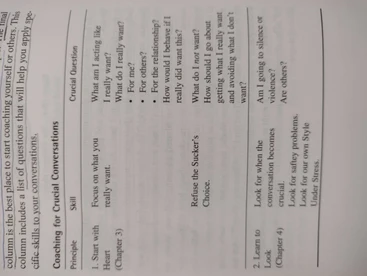
1- Start With Heart -Chapter 3
2- Learn To Look -Chapter 4
3- Make It Safe -Chapter 5
4- Master My Stories (part 2) -Chapter 6
5- STATE My Path -Chapter 7
7-Move To Action -Chapter 9


Comments

Popular posts from this blog

(Perspective) Biblical: Freedom In The House Of Mourning

Countless times I've expressed the expansive variety of options we're gifted here on Earth. Why do we limit ourselves to options ABCD, though? We're told we have free will. We're told we can do what we want with our bodies and choose when to have kids  But what does it really look like to have free will? I'll tell you now. Not caring about the options at all. Seeing everything as a gift. Realizing this world was designed to be enjoyed and lived in to the fullest extent possible. Again, why limit ourselves to simple options? Pick whatever car you want (as long as it's the color options they've presented you with.) Eat whatever type of french fry, icecream, or food that is available on the menu list at your favorite restaurant. We have personal preferences and there's nothing wrong with having options and opinions. The question poised here is simple: Are you really free, or just given options?  I was blessed to hear a wonderful sermon that presented this w...

"For The Love of Vice" Social Causes Fridays Disucssion 17June2022

Intro: Shout out to Author David T. Courtwright author of Forces of Habit book series we're going through on Fridays. Taking a break this week to discuss issues surrounding the Forces of Habits: Homelessness, addictions, reasons behind it, and possible solutions. Next week we'll address The Big Three: Opium, Cannabis, Coca "For The Love of Vice" Social Causes Fridays 3 Major Talking Points : 1 Commentary and Catalyst Behind The Use 2 Drugged Up Homeless Nation 3 Can WE Fix This? Possible Solutions Segment One: Catalyst Behind the Use-Commentary and reasons people are addicted to controlled substances -Objective in having these Social Causes discussions: Better understanding of our history to better understand the present circumstances many are faced with. - What in the history was taking place during certain expansions of specific controlled substances? During WWI Morphine use was made more popular. Many wars took place due to controlled substances. In today'...

"Yeah, But: Advice For Tough Cases To Change Your Life Chapters 11 & 12 ...

For Our Wednesday Business Tech Talks Crucial Conversations Book series Youtube Podcast A Man Surprised is Half Beaten - Thomas Fuller 3 Major Talking Points : 1 Sample From The "Yeah, But" Examples 2 Change Your Life Chapter 12 3 Digital Assistance and Further Teaching Tools. Segment One: "Yeah, But: Advice For Tough Cases" Pg 194 - "Yeah, but what if I can't calm down quickly enough? I've been told not to go to bed angry, but sometimes I think I need time alone?" - " What, but what if I don't trust the other person? How am I supposed to deal with that?" And other examples of extreme cases -1 Example out of 17 that you can read from pages 194-214 -Pg 200 Failed Trust: " I don't know what to do. I'm not sure I can trust this person. He missed an important deadline. Now I wonder if I should trust him again." -The Danger point : "People often assume that trust is something you have or you don't ha...